

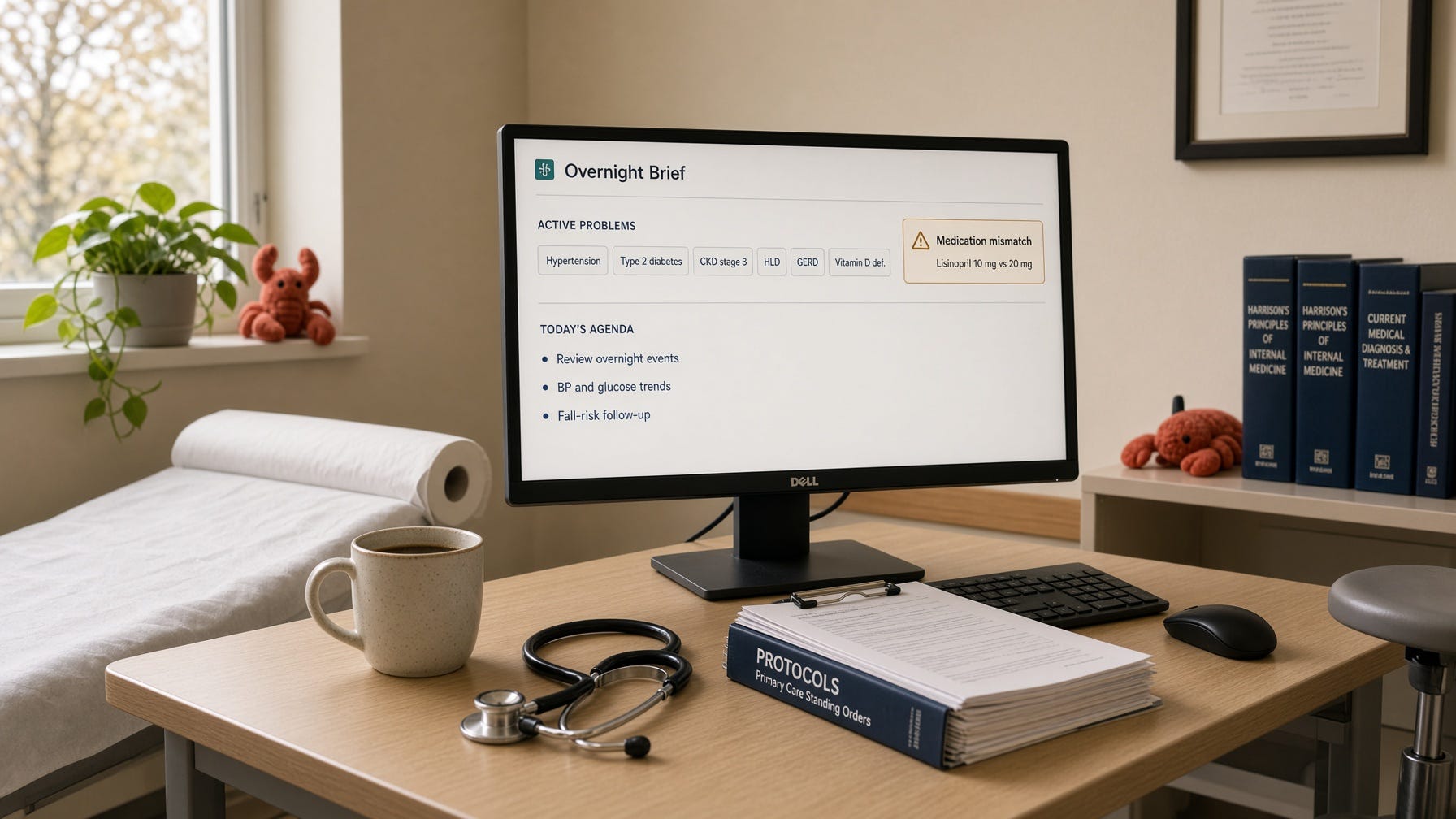
Tuesday morning, September 2026, 7:10. I am looking at a one-page brief assembled overnight by the software. The patient is 74. She already sees a cardiologist, a nephrologist, and a rheumatologist. Nine days ago she left the hospital after three nights for a heart-failure flare. The brief fits on a single screen: current problems, the med changes made at discharge, two open care gaps, the June nephrology note, and one line I did not expect — the furosemide dose in the discharge summary does not match the dose on her medication list. Three years back, a mismatch like that would have appeared, if it appeared at all, in the last two minutes of the visit. Chart prep on a patient like this used to take me about nine minutes. It now takes about three, and those three minutes are better spent.
The title is already half true. Today the software reads her chart first. What I am forecasting is what it will be allowed to do after that reading, and what remains on my side of the desk.
Colleagues still ask, usually in the hallway and usually with a half-joke attached, what 2030 looks like and whether the job survives it. I have worked the forecast long enough to answer without the joke.
Short version: I do not expect AI to replace me between August 2029 and August 2031. I expect to work as the accountable senior physician inside a partly automated care cell — a small team of clinicians, a nurse or care coordinator, medical assistants, and software, jointly responsible for a panel. Software will see every chart, result, message, and outside record before any of us do, and it will draft almost every artifact I sign. Routine work will be finished by the team under written protocols. My share will be the ambiguous and consequential diagnoses, the exam, the contradictions, the preference-sensitive choices, exception review instead of total processing, and authorship of the rules the cell runs on. First-pass cognition and clerical production go to the model. Final synthesis, relationship work, and accountable judgment stay with me. Direction: high confidence. Speed: moderate confidence. How much the software will be allowed to execute without a person in the loop: genuine uncertainty.
That last sentence is the forecast in compressed form. The rest of this essay is the work behind it, including the arguments that cut against me.
What the evidence will actually carry
AI in clinic is no longer a novelty. The American Medical Association’s 2026 survey of 1,692 physicians, fielded in January and February of this year, found 81 percent using AI in practice, up from 38 percent in 2023. The uses that dominate are clerical: discharge instructions, care plans, chart summaries, translation, and draft messages. In that same survey, 88 percent voiced some concern about skill loss. Asked for the single most important safeguard before an AI recommendation is acted on, 53 percent named mandatory physician review. Relief about the burden and anxiety about the judgment sit in the same respondents. I hear the same pairing in my own pod.
The real-world evidence is much smaller than the promotional claims. A forecast that pretends otherwise is hope dressed as data.
Begin with the ambient scribe, the one clinical AI tool that has clearly won the market. A University of Pennsylvania study of 46 clinicians in JAMA Network Open (February 2025) found an ambient scribe cut note time per appointment by about 20 percent, from 10.3 minutes to 8.2, lifted same-day closure from 66.2 percent to 72.4 percent, and cut after-hours documentation by roughly 30 percent. A larger Mass General Brigham and Emory study in the same journal (August 2025) reported burnout among Mass General Brigham users falling from 52.6 percent to 30.7 percent over 84 days. That result is observational, drawn from self-selected users answering a survey. An effect that large from a documentation tool is a signal about relief, not a measured clinical outcome. Output is a separate question. A UCSF analysis of 1,565 physicians and about 1.2 million encounters, published in January 2026, found adopters gained 0.80 additional patient encounters per week — a 2.8 percent rise in visit volume. Real, and nowhere near the tenfold visit productivity that gets talked about on conference stages. AI-drafted portal replies, in a Stanford study of 162 clinicians, reduced perceived task load and work exhaustion without a measurable time save.
The diagnostic literature is even less friendly to unsupervised generalist care. Caveat first: these studies use written vignettes, not patients. A randomized trial of 50 physicians in JAMA Network Open (October 2024) found the GPT-4 group scored 76 percent on diagnostic reasoning versus 74 percent for the conventional-resource group, a difference that did not reach significance, even though the model alone beat both groups. Strong solo model scores do not automatically make a strong human-AI team. Worse: a 2026 randomized trial in NEJM AI, run in Pakistan with 44 physicians after 20 hours of AI-literacy training, saw diagnostic accuracy drop from 84.9 percent with error-free AI suggestions to 73.3 percent with erroneous ones. One trial, one setting. I would not write policy from it alone. The direction — that training does not immunize a clinician against a confident wrong suggestion — matches everything else we know about automation bias. A systematic review in JAMA Network Open (September 2024) found 43 predictive machine-learning algorithms in primary care; most failed to meet even half of the review’s evidence requirements across development, validation, impact, and implementation.
My reading, and it is a reading rather than a finding: capability will arrive before organization does. Between 2029 and 2031 the constraints will be execution permission, workflow integration, liability, reimbursement, and governance. They will not be whether a model can write a respectable assessment and plan. That threshold is already behind us.
Three scenarios, and the base rate against me
These percentages are subjective. I am putting them on the page so August 2031 can score them. Two columns, because the reference class changes the answer.
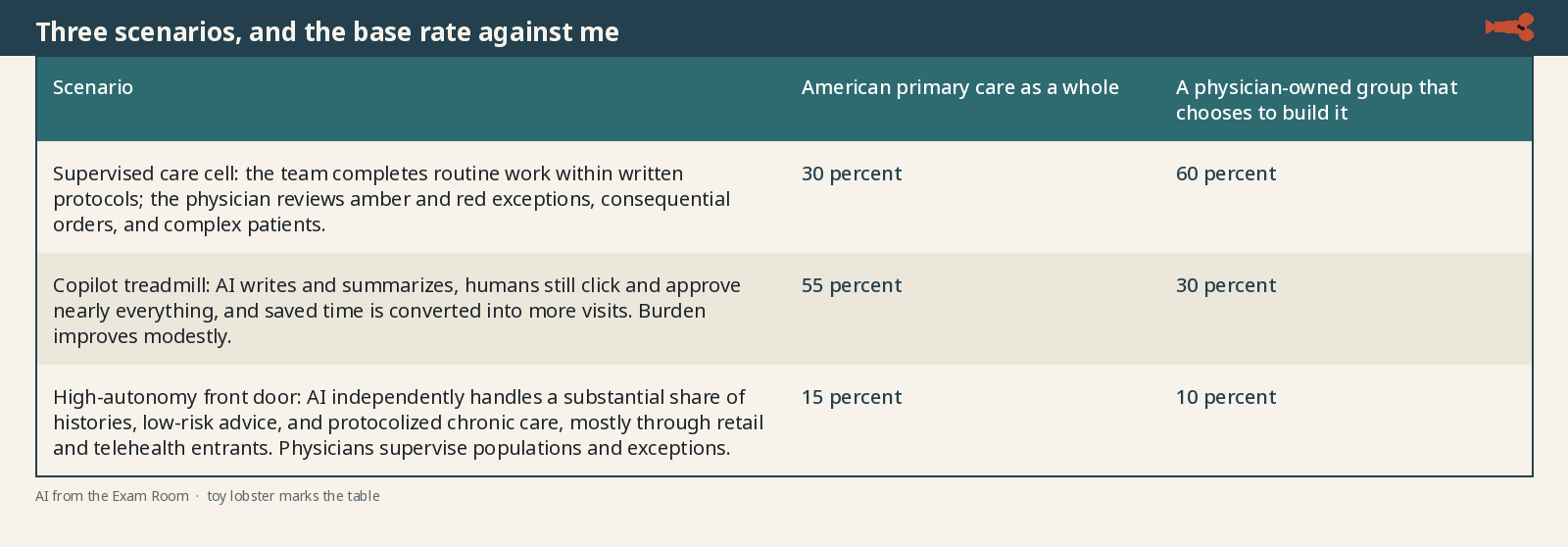
Column one is the null. I want that to be explicit. Every prior efficiency technology in medicine has seen recovered time recaptured as throughput. Under fee-for-service, a saved minute is an unbilled minute until someone fills it. A language model does not rewrite that arithmetic. For the field as a whole, the treadmill is the most likely 2030. The front door, if it arrives, will be built by firms that sell visits to consumers, not by incumbent practices.
Column two is a bet against that base rate, and it is only defensible for a narrow class: physician-owned groups that already carry full risk for a large share of the panel and that decide, in advance, what the saved minutes are for. My group sits in that class. That is also why a reader should discount my 60 percent. I am building scenario one. I want scenario one. Motivated reasoning is sharpest where the stakes are personal. The number is my estimate after I tried to correct for that. It is not an empirical claim. Use column one if you are not in a position to choose.
The work, task by task
“AI will transform primary care” is useless in the room where the work happens. Below is what I expect each part of the job to look like in 2030 inside the care cell, and what I expect to remain mine.
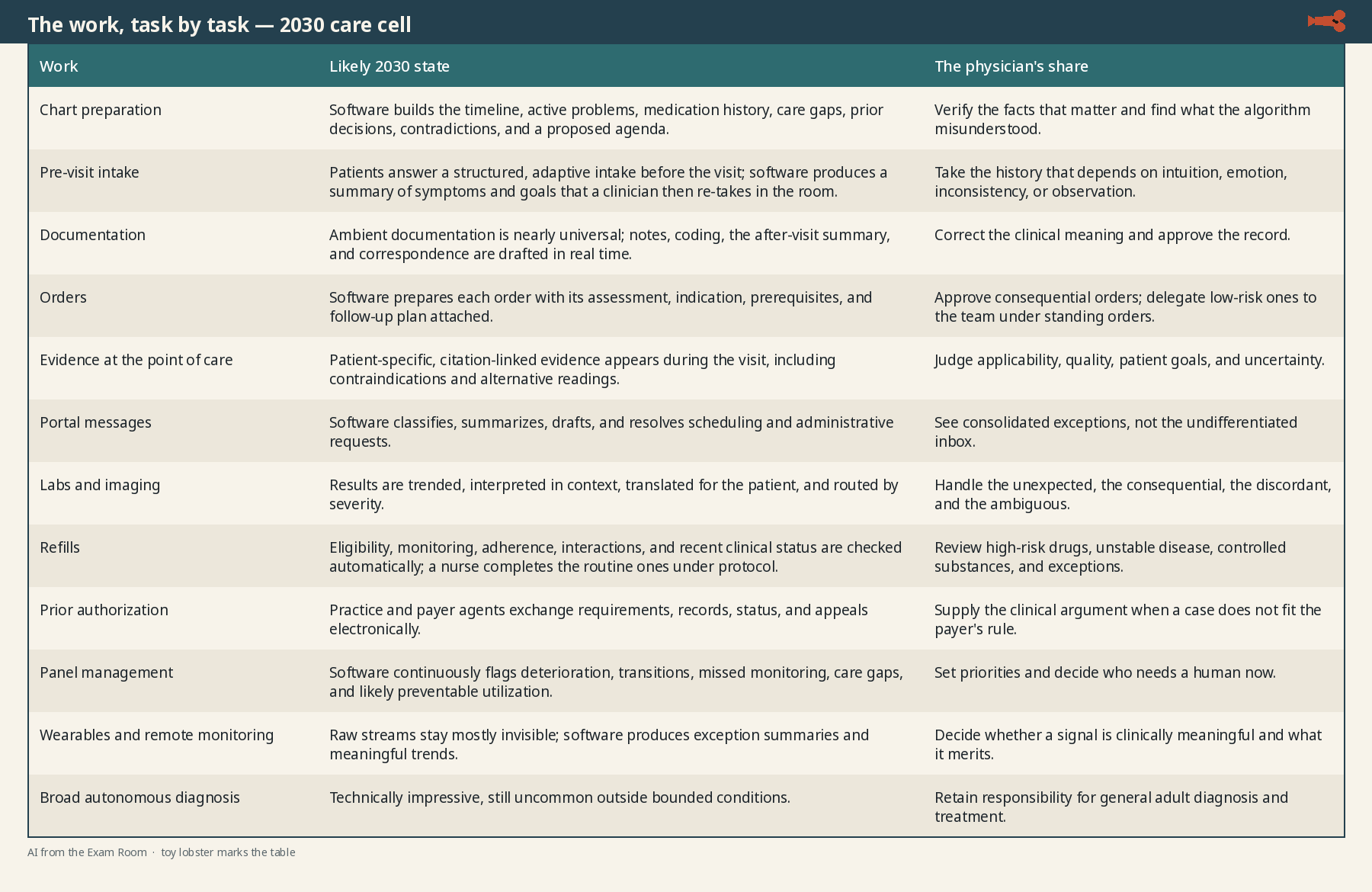
Two points about that table have to be said in sentences. A table lets a writer skip the argument.
First: who is in the cell. The physician is not alone with the model. In my practice the routine layer already runs through a nurse practitioner colleague, a nurse, and medical assistants. In Texas the legal mechanism is decades old. A physician delegates medical acts under standing delegation orders and prescriptive authority agreements, and the act remains the physician’s. Advanced practice clinicians already carry a large share of routine primary care nationally. The care cell does not reverse that. It adds a surveillance layer and a drafting layer and makes the delegation explicit, on paper, with an audit trail. When this essay says “the physician,” it means the accountable senior clinician on that team. I use “physician” rather than “clinician” not because the other clinicians matter less. I use it because the license that carries the protocols has to belong to someone, and in my cell that someone is me.
Second: what “delegate to the team under standing orders” does and does not mean for software. A standing order names a qualified person. Software is not a qualified person. Any action the software completes on its own is therefore either an act of mine, done by a tool I configured and signed for, or an act of a delegate who used the tool. There is no third legal category in 2026. I do not expect one by 2031. That is why the high-autonomy scenario stays small, and why the design work later in this essay is mostly protocol writing rather than software shopping.
Vendors are already walking this path, and the convergence matters more than any one press release. On November 4, 2025, athenahealth announced an AI-native clinical encounter. On August 13, 2026 it folded its own ambient documentation into athenaOne at no extra charge. Epic’s AI Charting reached general release in February 2026, pairing ambient documentation with queued orders, plus a clinician-facing agent and a patient-facing one inside MyChart. Oracle Health’s clinical agent added order creation in February 2026 and coding, dictation, and chart review on August 19, 2026. These are roadmaps and announcements, not effectiveness trials. Three of the largest EHR vendors describing the same encounter is a signal about capital allocation. It is not a signal about outcomes, and I am not treating it as one.
For a group like mine, athenaOne will probably remain the legal system of record through 2031. The screen I actually work in may become an orchestration layer that gathers the relevant information, starts the action, and writes the result back. The 7:10 brief this morning came from one such layer, built by Maticinside.ai. Disclosure: I sit on the Catalyst Physician Group Digital Council, a design partner of Maticinside.ai. I work on these products directly. I am a physician part-owner of Catalyst Health Group, which has a financial interest in Maticinside.ai. Weigh what follows with that in view. I name the tools because they sit on my desk, not because I am writing a product recommendation. Later I will mark the place where my interest and my forecast are hardest to separate.
A Tuesday in 2030
A forecast is only honest at the scale of a specific morning. This is the morning I expect, drawn inside the supervised scenario and no further.
7:30 a.m., huddle. I open a ranked briefing rather than an inbox. Five patients need attention before their scheduled visits. Three charts carry medication mismatches. Two recently discharged patients still have unresolved issues. Four abnormal results were already handled by the nurse under protocol; one is waiting for my judgment. Under that sits a short list of panel-level opportunities whose expected benefit clears the cost of outreach. Every scheduled patient has a one-screen brief: why today, what changed, what the patient says matters most, which decisions are still open, which evidence bears on those decisions, and what the proposed next actions are.
During the visit. The patient has finished a structured intake and named her priorities. Outside records have been reconciled and an agenda has been suggested. I spend more of the visit looking at her than at the screen. I take the history again, in my own order, because the intake is a draft and the patient is the source. I clarify what does not fit, I examine her, and we negotiate the plan. The software listens, updates its picture of the case, and prepares the note and coding, the orders and referrals, personalized instructions, monitoring and contingency plans, follow-up timing, and something we do not have today: a decision ledger that records the evidence, the uncertainty, the alternatives considered, and the reason for the choice. I do not give every generated sentence equal attention. I review the parts that carry clinical consequence.
Between visits. Today I handle about 40 portal messages a day at roughly 90 seconds each — an hour of every clinic day spent on items that mostly did not need a physician. In 2030, instead of ten unrelated interruptions, I get a compact approval queue in three colors. Green items were finished by the team under a protocol I signed; they remain visible for audit. Amber items are drafted and waiting for a short review. Red items need direct physician reasoning or immediate attention. The step that separates scenario one from scenario two is the move from a model that drafts to a team that executes inside bounded authority. Drafting without execution turns a typing burden into a proofreading burden and then calls the swap progress.
Afternoon panel work. I keep a short protected block for patients who are not in the office: a worsening blood-pressure or glycemic trajectory, a high-risk transition, unexplained nonadherence, a frail patient collecting small warning signs, someone the surveillance layer thinks would benefit from earlier intervention. Payment is starting to support that block. Medicare’s Advanced Primary Care Management codes, created in the 2025 physician fee schedule, pay a monthly amount tiered by complexity rather than counted in minutes, in exchange for longitudinal access, coordination, population management, and enhanced communication. The CMS LEAD model, announced December 18, 2025, with performance years running from 2027 through 2036, goes further and tests population-based payment for accountable care organizations across a ten-year horizon. Neither guarantee creates the afternoon block by itself. Both make it fundable. Without one of them, the block does not survive contact with a fee-for-service schedule.
End of day. The target is not literally zero work. The target is zero unexamined backlog. Almost all of the notes are closed. No raw inbox is waiting to be reconstructed for another hour. A few exceptions have been deferred on purpose, each with an owner and a deadline. The last five minutes go to the day’s AI overrides and near misses. That is how the protocols improve.
How much more productive, honestly
A tenfold rise in visits per day is neither plausible nor desirable by 2031. Current evidence says documentation AI alone buys relatively small capacity gains. A defensible forecast for a well-redesigned practice looks more like this:
80 to 95 percent same-day chart closure.
40 to 60 percent fewer raw inbox items personally touched by the physician.
30 to 50 percent less physician clerical and administrative time.
10 to 25 percent additional visit capacity, if the organization chooses to convert saved time into appointments.
Two to four times more completed care loops per physician hour, because the team and the software can run several routine processes in parallel while I am in a room.
Those are forecast ranges, not trial-derived effects. Treat them as a bet I am willing to be scored on.
The last range needs a definition or it is not a bet. A care loop, as I intend to count it, is one patient need that was identified, acted on, communicated to the patient, and closed, with a timestamp on each step. Nobody publishes that number today. Fair objection: a metric nobody measures cannot be scored. Answer: start measuring it. I intend to count my own panel’s loops in a monthly, de-identified report before the forecast window opens. Second fair objection: nobody pays for a closed loop under fee-for-service, so a practice without a risk contract or the monthly management codes has no reason to count them. That objection is correct. The tenfold reframe is real inside payment that buys it and a slogan everywhere else.
The reframe is this. Counted as visits performed, no primary care practice reaches ten times. Counted as important patient needs safely identified, acted on, communicated, and closed per physician hour, ten times is within reach, because most of those loops never required my hands. The allocation choice is the whole game. If AI saves four minutes and the schedule quietly absorbs another patient, we get the copilot treadmill. If those minutes go to hard reasoning, patient presence, panel oversight, or finishing the day’s work inside the day, we get the outcome most of us went into medicine for.
What stays mine, and why the reason is not what you think
I used to keep a list of the work the machine could not do: read a face, notice a gait, deliver bad news, sit with uncertainty. The list is a comfort, and it is wrong the way comfort usually is. In a 2023 JAMA Internal Medicine study, licensed clinicians blinded to source preferred a chatbot’s answers to physicians’ answers on real patient questions 78.6 percent of the time, and rated the chatbot more empathetic by a wide margin. Google’s diagnostic conversational agent was rated more empathetic than primary care physicians by standardized patients in a Nature paper in 2025. Gait and affect are beginning to appear in research pipelines scored from video and voice, from what I can see, though nothing of that kind has reached my clinic. Competence at the humane parts of the job is rising. An essay that promises otherwise is leaning on hope rather than data.
So the durable claim is not about capability. It is about accountability and presence.
I will still be the person who notices that the stated problem is not the real problem, because I am in the room and the software is in the record. I will still be the person who decides that this guideline is wrong for this patient, and who can be asked to defend that decision by name. I will still be the person who balances three individually reasonable treatments that conflict, and who accepts that the balance will sometimes be wrong. I will still be the person who decides when not to investigate — a decision no protocol will ever write for me. I will still be the person who delivers bad news and stays in the room afterward, not because software cannot compose the words, but because a patient in that moment is owed someone who will be there next month. I will still be the person a patient trusts enough to reveal the detail that changes the diagnosis, a trust built visit by visit and never collected by an intake form. I will still be the person who signs, which means I am the person who answers.
These are not leftover chores after the machine takes the interesting work. They are the central work of general internal medicine once the clerical load is lifted, and they stay mine not because I will outperform a 2030 model at them, but because someone with a license and a relationship has to own them.
Workforce math points the same direction. The Health Resources and Services Administration continues to project substantial primary care shortages through the 2030s, including in general internal medicine. New capacity is far more likely to be absorbed by aging, multimorbidity, access gaps, and unmet demand than to erase the need for clinicians. A practice that gains 20 percent capacity in 2030 will not be hunting for physicians to lay off. It will be looking at a waiting list that finally moves.
The honest counterweight
I have made the case for the supervised care cell. Here is the strongest case against it, hazard by hazard, with the guardrail I would put in front of each and a frank note on which guardrails are tested and which are hypotheses.
The productivity treadmill. The most likely failure is not a catastrophic model error. It is that every saved minute becomes another appointment, another message, another quality measure. That is the base rate — column one of the scenario table — and the reason I discounted my own forecast above. Guardrail: freeze schedules during initial pilots, and allocate reclaimed time in writing before anyone measures capacity, so the organization has to decide on the record what the minutes are for. This is a governance intention, not a market force. It holds only while the people who signed it remain in charge.
Automation bias and the loss of diagnostic independence. A confident wrong recommendation pulls even trained clinicians toward the wrong answer. That is the 2026 NEJM AI result: an 11.6-point drop in raw accuracy that 20 hours of training did not prevent. Guardrail: for complex or high-stakes presentations, record the clinician’s own problem representation before the AI differential is displayed, and track overrides and disagreement rates rather than acceptance rates. I should be plain that this guardrail is a hypothesis. No trial has tested commit-before-reveal in a clinic. It is the design I would test first, not a proven fix. A physician who never disagrees with the model is not supervising it.
The law decides who acts, and the carrier decides who pays. Delegation to people under standing orders is settled law. Delegation to software is not a category the statute recognizes, and neither, so far as I can find, is it a category most malpractice policies name. If a green item completed by a tool under my protocol turns out wrong, the claim lands on my license. Whether my carrier treats a protocol-driven action by a tool the same way it treats a standing order executed by a nurse is a question I have not seen answered in writing. Texas has already started legislating the edges: Senate Bill 1188, effective September 1, 2025, requires practitioners to disclose the use of AI in a patient’s diagnosis or treatment, and House Bill 149, effective January 1, 2026, adds its own written-disclosure requirements. Guardrail: before any green protocol goes live, get the carrier’s position in writing and put the disclosure in the patient’s hands in plain language. A group that has not done both is running the 60 percent scenario on the 10 percent scenario’s legal footing.
Systematic error at scale. A human makes individual errors. A centrally deployed model can make the same error across thousands of patients on the same afternoon. Guardrail: local validation, staged rollout, subgroup monitoring, version tracking, rapid rollback, and a named clinician with authority to stop the system. If nobody in the organization can name the person who can pull the plug, the organization does not have a governance process. It has a vendor contract.
Proofreading becomes the new burden. Longer notes, recommendation lists that never end, and low-value alerts that fire on every patient can each consume the time the tool supposedly saved. Guardrail: measure physician touch time and cognitive load, not merely whether a draft was produced. A draft nobody can review quickly is not an output. It is a new input.
The margin goes to the payer. Payers will automate utilization rules and denials first, because their return is immediate and their scale is larger. Practices will need agents that assemble documentation, follow status, and prepare appeals. The CMS Interoperability and Prior Authorization final rule, published January 17, 2024, already requires affected payers to give a specific reason for every denial as of January 1, 2026, and to stand up FHIR-based prior authorization interfaces by January 1, 2027. That is the machine-to-machine layer this arms race will run on. The likely equilibrium is rising total friction, software vendors on both sides capturing the surplus, and the deeper-pocketed side keeping the margin. Decades of payer rate asymmetry say that side is not the independent practice. That is not an argument against building the defense. It is an argument against expecting the defense to be a competitive advantage, and a reason the care cell is cheaper to run inside a risk contract than outside one.
The people the cell is built around. A pre-visit intake moves work onto the patient. On a Medicare-heavy panel, a meaningful share of patients will not complete it, will complete it inaccurately, or will need a family member to do it, and the cell has to run for them too. Patients will also arrive with their own consumer health agents. A new chief complaint — “my agent says” — will take clinical time to unwind rather than save it. Nobody has designed the consent. Texas now requires disclosure, but disclosure is not the same as a patient being able to refuse AI-mediated triage and still receive care, and nothing in my Tuesday in 2030 shows what that opt-out looks like. Guardrail: every automated path needs a human path beside it that is not a punishment for choosing it. Outcome measures have to be reported by age, language, and health literacy, or they will hide exactly the patients the design forgot.
Privacy, liability, and trust. The Food and Drug Administration’s framework for generative clinical systems is still forming. The discussion paper its Digital Health Advisory Committee took up in November 2024 remains the most specific document it has produced, and that committee recommended that patients be told when a generative AI device was used in their care. HIPAA business-associate obligations attach the moment a third-party AI service touches protected health information. None of these is a reason to wait. All of them are reasons the high-autonomy scenario stays at 10 percent.
What about the version where the software just does it
The strongest objection runs the other way. Frontier models already beat physicians on structured diagnostic tasks, the objection goes, so the supervised care cell is a transitional arrangement that flatters physicians, and by 2031 the accurate description of my job is that the software practices medicine and I hold the license.
The objection is right about model capability and beside the point about what decides deployment. As I read the landscape, four systems currently converge on requiring a licensed physician for general adult care: device regulation, state statutes on AI and the practice of medicine, malpractice liability, and the rules for who can bill Medicare. Each is under active review. The proposed 2027 physician fee schedule, released July 14, 2026, even includes a request for information asking whether AI companies should deliver Medicare annual wellness visits through affiliated physicians, with comments due September 14, 2026. The question is on paper. None of the four requirements will be gone by 2031. Regulatory sandboxes will let bounded, protocolized tasks — maintenance refills being the obvious first case — run with less review as safety data accumulate. That is the 15 percent column growing at the edges, and I expect it to keep growing. General adult diagnosis and treatment, the work in the last row of the table, will still carry a physician’s name when the forecast window closes. The right way to hold the objection is as the reason my third scenario is not zero.
What this means for the physician who runs a panel
If you run a panel, the highest-value move is not becoming an expert user of an AI scribe. Scribes are being commoditized in front of us. The move is to become one of the people who designs the operating model the scribe sits inside. Map the work by decision rights, not by job title. Pick one high-volume workflow — labs, refills, or portal messages — and redesign it end to end rather than automating a single step. Record a reason code every time you override the model. Those overrides are the most valuable design data your group will ever collect. Protect reclaimed time during pilots, in writing, before anyone measures capacity.
If you are building an orchestration layer for primary care, note generation is not your moat. The EHR vendors will give it away, and one of them already does. My group’s design conversations keep returning to six assets that look more durable: a local decision-rights architecture, with every action classified green, amber, or red and written escalation rules; end-to-end workflow closure, so the system does not stop at “recommended a referral” but confirms scheduling, receipt of the consultation, incorporation of the result, communication with the patient, and the next action; the group’s own clinical reasoning corpus, capturing why experienced clinicians accept, alter, or reject recommendations; a physician-facing decision ledger carrying source, date, provenance, uncertainty, assumptions, contraindications, and what would change the recommendation; local outcome measurement, from same-day closure and physician inbox minutes through override rates, near misses, patient trust, performance across demographic groups, and whether saved time was actually preserved; and one orchestration layer rather than six, because separate tools for notes, inbox, labs, referrals, population health, and patient communication that cannot share context will recreate the EHR problem in a newer interface.
This is where my interest and my forecast are hardest to separate, so I will say the uncomfortable part myself. That list describes what Maticinside.ai is building for my group. It also describes what Epic and athenahealth can build, and probably will, because every item on it is software. The honest reading is that none of the six is a vendor moat. What a physician group cannot buy from any vendor is the decision rights, the protocols, and the corpus of its own clinicians’ reasoning. The group that hands those to a vendor along with the software has outsourced the only part that was ever its own.
Our design principle has been “software drafts, physician decides,” and it has served us well. By 2030 I would extend it: software drafts, the team executes within protocol, and the physician decides the consequential exceptions and governs the system.
If you are a healthcare leader deciding what to do with the minutes, decide it before the pilot, and say it out loud. Which path you pick reveals what you believe physicians are for.
My own plan, dated
Forecasts about other people are cheap. Here is mine for me.
Between now and the end of 2027, I map my work by decision rights, redesign one high-volume workflow end to end, establish baselines for touch time, backlog, closure, safety, staff burden, and patient experience, and log a reason code for every AI override. Through 2028, the previsit, encounter, postvisit, inbox, and follow-up steps connect into one workflow with green, amber, and red autonomy, longitudinal briefs, structured intake, payer APIs as they come online, and a governance process with rapid rollback authority. Through 2029, episodic inbox management gives way to continuous panel surveillance, with the team executing protocols for stable refills, normal results, routine monitoring, preventive outreach, and selected chronic-care steps, validated on my group’s actual population, which skews older, multimorbid, and polypharmacy-heavy.
By 2030 the job I am aiming for is senior internist and clinical operating-system architect, and the calendar would say so: roughly half my time in direct patient relationship, examination, and shared decisions; 15 to 20 percent on complex exceptions; 10 to 15 percent on panel-level oversight; 10 percent on team development and teaching; 5 to 10 percent on AI governance and workflow design; and under 10 percent on documentation and clerical administration.
Any physician doing this design work should have a formally protected half-day for workflow governance, quality review, and clinical-system design. I intend to ask for one. Without protected time, design work stays an unpaid evening activity, and the organization loses most of the value of the experience it is paying for.
The compressed version: I will still see a substantial number of patients in 2030, and the visit will no longer be the sole container of care. Software will see almost every chart first and write almost every artifact first. Routine work will be completed by the team under explicit protocols. My highest-value work will be four things: relationship-centered diagnostician, decision-maker for uncertainty and consequence, supervisor of clinical exceptions, and designer and governor of the care system. My experience becomes more valuable only if I convert it from tacit individual knowledge into protocols, escalation rules, worked examples, and written decision rationales. The winning future is not me plus a faster scribe. It is me directing a care cell that can safely act on far more patient needs than I can touch, while keeping my attention for the moments that require a physician.
The same patient, four years on
The woman from this morning’s brief will be 78 in the fall of 2030. If the forecast holds, the software will have noticed her creatinine drifting six weeks before her next scheduled visit and checked it against her diuretic dose and the nephrology note. It will have drafted a message and flagged the item amber. The nurse in my cell will have reviewed it under a standing order I signed in 2028, sent the message, and moved the visit up, and I will have seen the whole loop in the next morning’s audit line. Her intake will say she is worried about her balance and did not want to bother anyone. The brief will flag the balance complaint as new, cross-reference her fall risk, and propose an agenda.
I will still be the one who walks into the room, watches her stand up from the chair, and decides that the balance problem is the visit. The software will have read her chart before I did. It will have been right about the creatinine. It will not have known what her face looked like when she said she did not want to bother anyone, and if by 2030 it can read that too, it will still not be the one who has to answer for what we do about it. That part of the job was never going to be automated, and by 2030 it is finally going to have the room it deserves.
Doug Fullington, MD is a practicing internist with over 25 years in primary care. He is a physician part-owner of Catalyst Health Group, which has a financial interest in Maticinside.ai. He has no other financial relationships with any of the clinical AI tools discussed. He writes about AI in primary care at AI from the Exam Room. The views expressed are his own.
A note on PHI and AI clinical tools: Even when a platform has a signed BAA, the HIPAA minimum necessary standard still applies. Most clinical questions can be answered with de-identified details (age, sex, relevant history) without names, dates of birth, or MRNs. Check your institution’s policies, which may add restrictions beyond HIPAA. The patient encounters described here are fictionalized composites and contain no patient-identifiable information.