
Efficiency Was the Staircase. Self-Actualization Was the Room.
I built my case for AI on the time it saved me. The time turned out to be the least interesting thing it gave back.

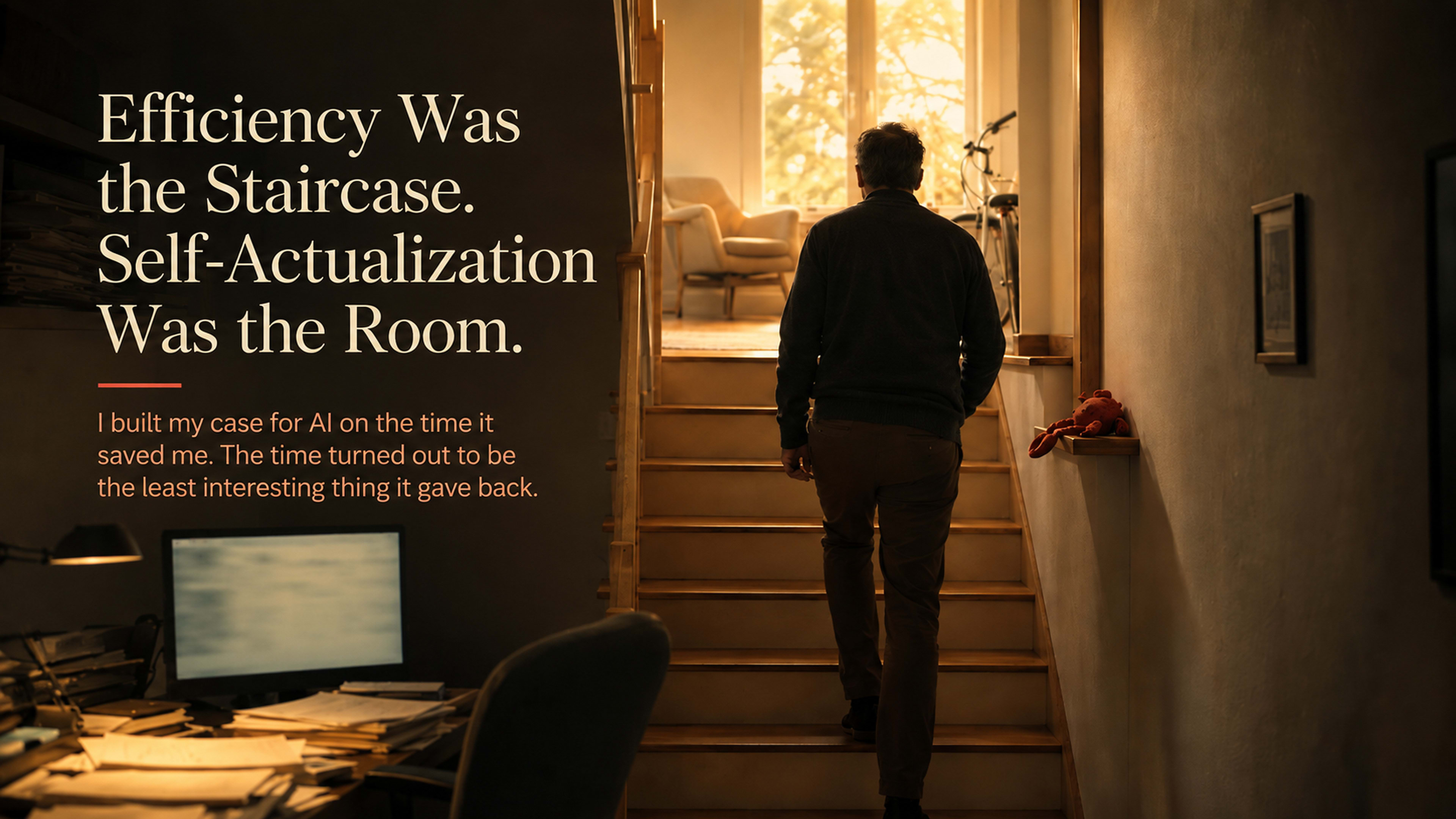
Efficiency Was the Staircase. Self-Actualization Was the Room.
I built my case for AI on the time it saved me. The time turned out to be the least interesting thing it gave back.
The short version: New AI workflows give me back about ninety minutes of clinical time a day and a great deal of cognitive load. For a while I thought that was the win. It was not. The reclaimed time and bandwidth are the base of a pyramid, and the real work happens at the top, where I use AI not to get answers but to challenge the beliefs I am most certain of: how I should contribute in a room, what twenty-five years of clinical conviction is worth, how I should eat. This is a piece about the difference between using AI to do more and using AI to become more, and about the discipline that keeps the second one honest.
On a recent Tuesday evening, my charts were already closed.
That sentence would have been science fiction two years ago. For most of my career, Tuesday evening meant the second shift: the notes I had not finished, the inbox I had not cleared, the slow accrual of work that followed me home and sat on the kitchen table like a guest who would not leave. New AI workflows have changed that. On a good day they give me back about ninety minutes of clinical time and a quieter head, and that night the quiet had arrived early.
There I sat with time I would not have had a year ago, dictating the day’s food into a model so it could add up the protein and the fiber I am now trying to track. It was a small task. When it finished, I did not close the laptop. I asked it to argue with me instead. I had held a particular belief about how I should eat for the better part of twenty years, and I wanted to know whether the belief still held or whether I had just stopped examining it. I asked the model to take the other side, to bring the best evidence against me, and to tell me where I was wrong.
That is the moment I want to write about. The moment is not the ninety minutes. It is what the ninety minutes were for.
The case I used to make for AI, the case I made here more than once, was a case about time. Time saved, work absorbed, minutes returned. That case is true, and it is the least interesting thing AI has done for me. The ninety minutes were never the point. They were the staircase. This is about the room at the top.
The case I used to make
For two years I have been the person at the meeting telling other physicians that AI is worth their hour. I have the receipts. The pre-visit prep that used to take me the better part of a morning collapses into a dictated paragraph. The portal replies draft themselves and I edit. The note is mostly written by the time I have finished thinking about the patient. Add it up and it comes to something like ninety minutes a day, plus the harder-to-measure relief of not carrying twelve open loops in my head at once.
I believed that was the headline, and I wrote it that way. I was wrong about the headline, though not about the facts. What I had described was real. It was also only the bottom of the structure.
Abraham Maslow drew human needs as a pyramid. The base is deficiency: safety, rest, the load you have to clear before you can attend to anything else. The top is self-actualization, the work of becoming the version of yourself your values point toward. The base does not make you whole. It makes the top possible. No one pursues self-actualization while they are drowning.
That is exactly what the ninety minutes did. They did not make me a better physician or a better person. They cleared the water. Efficiency was the staircase. It carried me up to a room I had not had time to stand in for years and left me there with a question I had been avoiding: what was I going to do with it?
What I actually do at the top of the pyramid
Here is what surprised me. The most valuable thing I do with a model is not ask it for answers. I ask it to challenge the things I am most sure of.
That runs against the grain of how an expert is supposed to use a tool. Twenty-five years in, my instinct is to lead with the conclusion. I have seen the pattern before. I am good at thinking on my feet, and for most of my career that was enough. The trouble with being good at thinking on your feet is that you stop noticing when you are standing still. A strong prior feels exactly like knowledge. The better you are, the more your beliefs are earned, defended, and therefore difficult to update on your own. That is precisely when an honest challenger is worth the most.
Take a meeting I prepared for this week. The old way, I would have walked in and offered the opinion of a clinician with more than twenty-five years of experience, delivered with conviction, shaped entirely by my own vantage point. Instead I used the model to understand the people who would be in the room: what they were responsible for, what problem actually kept them up at night, what a useful contribution would look like from where they sat rather than from where I sat.
The gap between those two contributions is the whole story. My first instinct was to be right. The prepared version was to be useful. I moved from offering my clinical perspective to translating it into something that connected with theirs, their purpose, their problem, the decision they actually had to make. Aristotle had a word for the skill of perceiving the right action in a particular situation rather than the correct one in the abstract. He called it phronesis, practical wisdom. I have read about it for years. This was the first time a tool helped me practice it on purpose. The maturity in it is real, and it is not flattering to admit I needed help getting there.
Take the software I now build, which I would once have told you was not for me. I am a physician, not an engineer. For most of my life I believed that building real tools required a foundation I did not have and was not going to acquire this late: years of computer science, a fluency whose window I had missed. That belief was load-bearing. It kept me a user of other people’s software and a critic of the parts that never fit my practice.
I put that belief in front of the model and asked it to take the work apart with me, not to write the code while I watched, which is its own kind of surrender, but to teach me the shape of each problem while we built, to explain every choice until I could defend it, and to let me drive. The reframe was small and it moved everything. I did not need to become a traditional engineer. I needed to become someone who builds well with a capable partner, which is a different skill, and the window on that one is open.
What came out the other side is real: a system that captures my thinking so I stop losing it, and small applications that fit my clinic the way the bought ones never did. The point is not the software. The point is that a belief about who I was still allowed to become did not survive contact with an honest partner.
Now take my own health, which is the harder thing to write about. Before a decade of hospital medicine rearranged my life, I was the kind of fit that does hundred-mile bicycle rides on a Saturday and eats from plants almost exclusively. Then came years of the particular stress that medicine is good at manufacturing. I gained a hundred and ten pounds. I spent a long time after that trying to find my way back, on a schedule that did not cooperate.
I used the model as a thinking partner through most of it, and the pattern repeated. I held a strong, almost moral conviction about how I should eat, built over twenty years: whole foods, plants, low protein. I resisted the new GLP-1 medications longer than some colleagues, until the cardiovascular and renal evidence got hard to argue with in my patients. Then I prescribed them. Then I took one myself.
What I did not expect was the question it forced. At the dose that works, the noise of appetite goes quiet, and the problem inverts. I was no longer fighting to eat less. I had to relearn how to eat well, how to get enough protein and fiber when nothing was asking to be eaten. So I sat the partner down and made it argue against my own dogma. Was my low-protein conviction actually supported, or was it an identity I had stopped questioning? What did the evidence say about muscle loss on these medications? Where was I wrong? I came out the other side having changed my mind. I need more protein than my younger self believed, and I can get it from plants and fish without raising the saturated fat I spend my clinic days warning people about. Now I dictate what I eat and let the model keep the count. My energy came back. The belief that needed updating was mine, and I would not have updated it alone.
It was the same move in three different rooms. In the meeting, the partner pulled me off my own vantage point. At the workbench, it pulled me off a story about what I was too late to learn. In the kitchen, it pulled me off a belief I had worn so long it felt like a fact. Not once did it hand me an answer to absorb. Every time it made me earn a better one. The value was never in what the model knew. It was in what it would not let me skip.
The two stages that keep it honest
None of this is safe by default. A fluent, agreeable model is perfectly capable of handing me a more sophisticated way to believe whatever I already wanted. The method matters, and mine has settled into two stages.
The first stage is to clarify what I actually believe and why. Before I ask the model to challenge a position, I make myself state it plainly and trace where it came from. Half the time the belief turns out to be inherited rather than examined, and that alone is worth the exercise.
The second stage is to attack it. I ask the model to answer, then I ask it to critique its own answer and give me a better one. I have it wear several hats at once, an evidence-minded skeptic, a specialist who disagrees with me, a generalist who thinks we are both overcomplicating things, and I step into the debate myself rather than watch it from the outside. Then I send it to the actual literature and the guidelines, because a confident argument is not the same as a correct one.
Underneath the method is a stance, and the stance does the work: humility and curiosity. The willingness to be the least informed voice in the conversation I convened. I keep coming back to one rule. An assertion from the model is a move to answer, not an answer to absorb. I test it the way I test a colleague who says “I think it is sarcoid” on rounds, not by believing it and not by dismissing it, but by asking what would have to be true. You can write the method down. You cannot write down the stance. The load-bearing part is what you bring, not the prompt you type.
If I had to name the engine of it in one sentence, it is this. I want to be challenged to go beyond my current level of understanding, and to apply what I find to living the most conscious life I am capable of. That is not a productivity goal. It is the reason the ninety minutes matter at all.
What this cannot do
This is the part the format requires and the part I most need to write for myself.
There is a structural caveat first. The top of the pyramid is a privilege of having cleared the bottom. If you are drowning in your inbox at nine at night, a Socratic partner is not your problem and not your solution. Clear the water first. The rest of this becomes available only after that.
A thinking partner cannot give you a stance you do not have. If you bring confirmation-seeking, you will get confirmation, dressed up well. The risk is sharpest exactly where the stakes are personal, which is to say where I most want a particular answer. I wanted my diet to be fine. A model built to please will help you rationalize as fluently as it helps you reason, and the two can look identical on the screen.
It cannot certify that it is right. The literature step is not optional decoration. I have watched a model build a beautiful, internally consistent argument on a wrong premise, and the more articulate it was, the more dangerous. Articulate is not the same as correct, and the gap between them is invisible if you stop reading.
It cannot protect you from cognitive surrender. If you let the partner do the believing, the muscle that forms beliefs goes slack. The degradation here is a posture problem, not a technology problem. The same tool that sharpens an engaged mind will hollow out a passive one.
It also cannot tell you whether you are decentering to serve a room or learning to manipulate it. Understanding what others need so you can help them and understanding what others need so you can move them are separated by intent alone, and intent is the one thing the model cannot audit for you. That line you have to keep yourself.
One plain disclosure, since this piece wandered into my own medicine cabinet. I prescribe GLP-1 medications and I take one. That is a disclosure, not a recommendation, and nothing here is medical advice.
If you have earned your beliefs
If you are a physician in the back half of your career, this is the invitation I would make. You have earned your priors. You are fast, and you are usually right, and that combination is exactly what makes it hard to notice the belief that has quietly gone stale. Spend the time the tools give you back not on more throughput but on the questions you stopped asking. Point the partner at the conviction you hold most tightly and tell it to take the other side.
If you are earlier on, the bar to start is lower than you think. One honest hour with a real problem, not a quick question, will teach you more than any essay will. Pay for the capable model and argue with it about something that actually matters to you.
If you are skeptical, keep the skepticism. It is the right instinct. Point it in both directions, at the model and at yourself.
I closed the laptop that Tuesday with the food logged and one of my twenty-year beliefs smaller than it had been at dinner. I did not feel optimized. I felt like someone who had just been talked out of being wrong by a patient colleague, which is a feeling I have chased my whole career and almost never had on a weeknight at my own kitchen table.
I wrote this essay the same way. I did not ask a model to write it. I asked it to interview me, then argue with me, until I knew what I actually thought. The method and the message are the same thing.
My bicycle is still in the garage, where it has waited out most of the last decade. Lately, on the quiet mornings, I have started to think about Saturday.
Companion piece: “The Consult I Ran on Myself” is the field note version of this idea, the same argument worked out inside a single clinical evening.
Doug Fullington, MD is a practicing internist with over 25 years in primary care. I write about AI in primary care at AI from the Exam Room. The views expressed are my own.
A note on PHI and AI clinical tools: Even when a platform has a signed BAA, the HIPAA minimum necessary standard still applies. Most clinical questions can be answered with de-identified details (age, sex, relevant history) without names, dates of birth, or MRNs. Check your institution’s policies, which may add restrictions beyond HIPAA. Any patient descriptions are fictional examples and no PHI has been included.
Very well said, Doug. Really appreciate these insights. I started using OE as a result of reading some of your earlier essays and have found the same insights you share to be very true.
The point about using our new free time wisely is sage and reminded me to do so. Thanks again.
James (EM, 25+ years)